

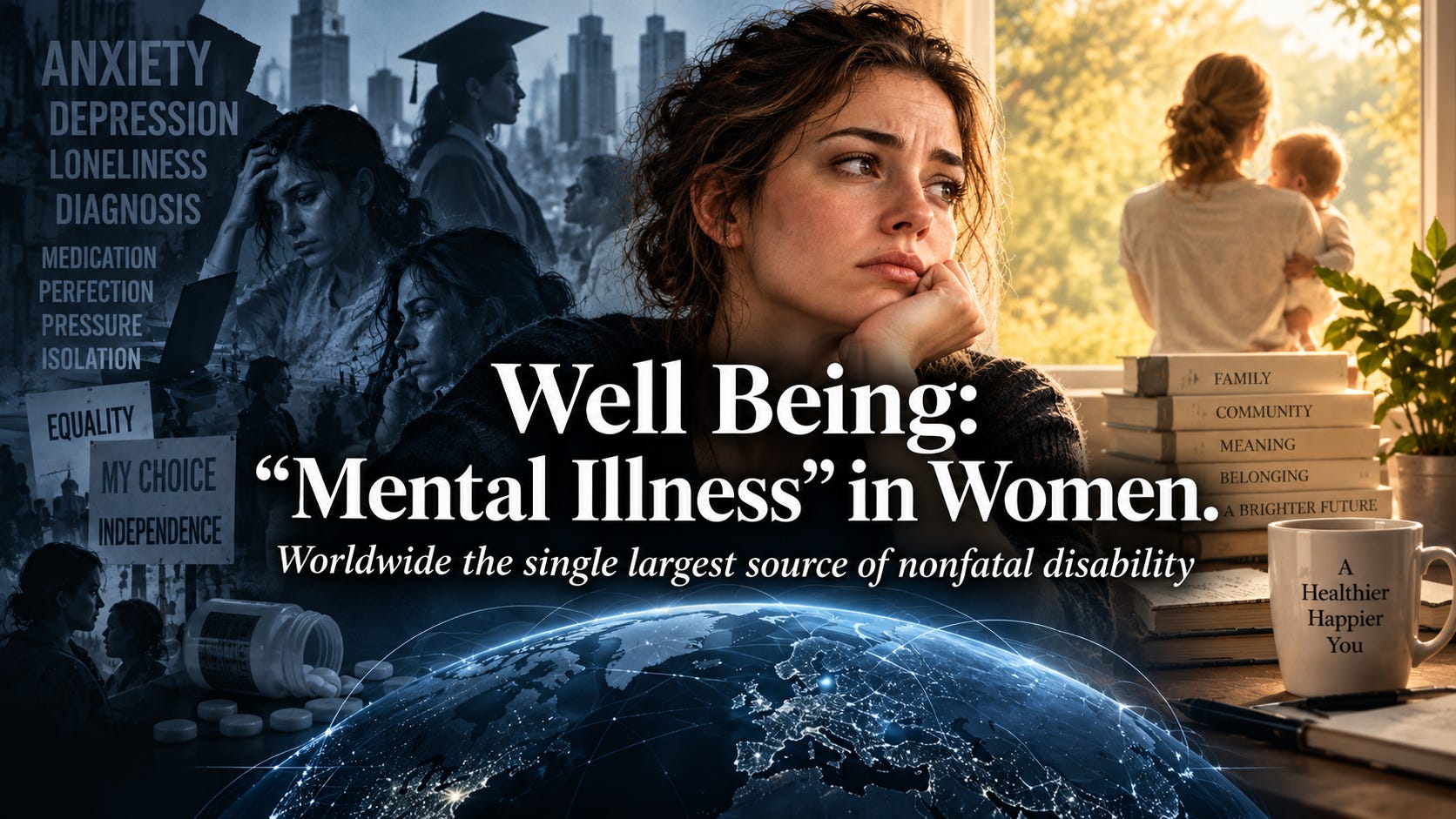
Audio Version:
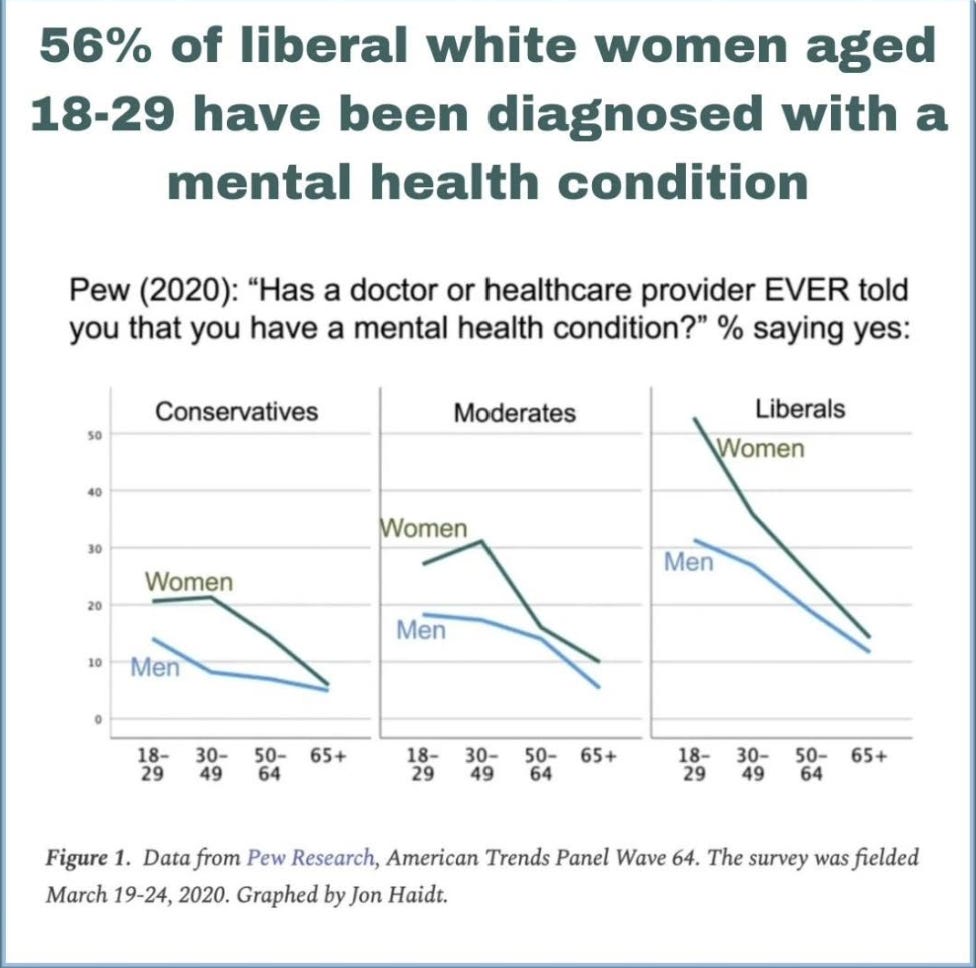
Back in 2020, Pew Research Center surveyed more than 11,000 Americans. Political scientist Zach Goldberg subsequently examined the underlying data and broke the results down by age, sex, race, and political ideology.
What he found was rather remarkable.
Among white women ages 18 to 29 who identified as liberal, 56.3% reported that a doctor or other health-care provider had diagnosed them with a mental health condition.
Not 15%.
Not 25%.
Fifty-six percent.
For white moderate women of the same age, the number was 28.4%.
For white conservative women, 27.3%.
In other words, young white liberal women were more than twice as likely as their conservative counterparts to report having received a mental health diagnosis.
Now, correlation is not causation. Perhaps liberals are simply more willing to seek psychiatric care. Perhaps conservatives are less willing to admit that they have a problem. Perhaps political ideology attracts people with particular personality traits rather than creating those traits. All perfectly reasonable possibilities.
But here is where it gets interesting.
Five years later, the numbers have not exactly moved in a reassuring direction.
Gallup found that only 15% of American women ages 18–29 surveyed from 2020 through 2024 described their mental health as excellent. In 2010–2014, that number had been 48%.
That is not a small decline. That is a collapse.
And the ideological divide is still there.
The 2024 American Family Survey found that only 12% of liberal women ages 18–40 described themselves as “completely satisfied” with their lives.
Among moderate women: 28%.
Among conservative women: 37%.
Liberal women were also nearly three times as likely as conservative women to report feeling lonely several times a week or more: 29% versus 11%.
So perhaps endlessly telling young women that they live in an oppressive society, that the world is on the verge of climate catastrophe, that words are violence, that disagreement is dangerous, that our President is evil, that the patriarchy is lurking behind every corner, that Western civilization is fundamentally corrupt, and that their personal unhappiness is caused by vast structural forces over which they have virtually no control is not actually a recipe for human flourishing.
Who could have guessed?
There is an important caveat. A 2025 study found that some of the apparent liberal-conservative mental-health divide may reflect differences in how people think and talk about “mental health.” When researchers simply asked people about their mood, rather than their mental health, much of the ideological difference disappeared.
Fair enough.
But that doesn’t explain away the extraordinary collapse in reported well-being among young women generally, nor does it make the life-satisfaction and loneliness data disappear. Maybe the question isn’t whether liberalism causes mental illness.
Maybe the more interesting question is whether a culture built around grievance, victimhood, fear and powerlessness is particularly attractive to unhappy people, makes unhappy people unhappier, or both. That seems like a question worth asking. Even if asking it makes someone very, very upset.
There is, however, an uncomfortable counterpoint to all this discussion of female unhappiness and mental illness. Men are far more likely to actually die by suicide. In the United States, the male suicide rate is nearly four times the female rate, and men account for roughly four out of every five suicide deaths. The disparity exists globally as well. Perhaps that exposes a deeper truth about the modern cult of victimhood. We have created a culture extraordinarily skilled at teaching certain groups to name every grievance, diagnose every distress, identify every oppressor and demand that society recognize their pain, while other forms of suffering remain remarkably easy to ignore. Young women may be reporting extraordinary levels of anxiety, depression and psychiatric diagnosis, but men are quietly killing themselves at vastly higher rates.
That does not diminish women's suffering. It suggests that our entire framework for understanding suffering may be badly distorted. A society obsessed with determining who is the victim and who is the oppressor can become remarkably blind to the human being who doesn't fit the approved narrative, particularly when that human being is male.
There is another possibility here that deserves far more attention: the diagnosis itself has become part of the epidemic. When more than half of young women in a political demographic report having been diagnosed with a mental health condition, the appropriate response is not simply to declare that half the population is mentally ill. It is to ask what the hell the health-care system is doing. Psychiatry has steadily expanded the boundaries of pathology, medicalizing distress, grief, anxiety, loneliness, adolescent turmoil, and ordinary difficulty as diagnosable disease. A system that can convert normal human suffering into a billing code, a prescription, and a lifelong medical identity should not be treated as a neutral observer of this crisis. At some point, an exploding diagnosis rate stops being proof of exploding disease and starts becoming evidence that the diagnostic machinery itself may be broken.
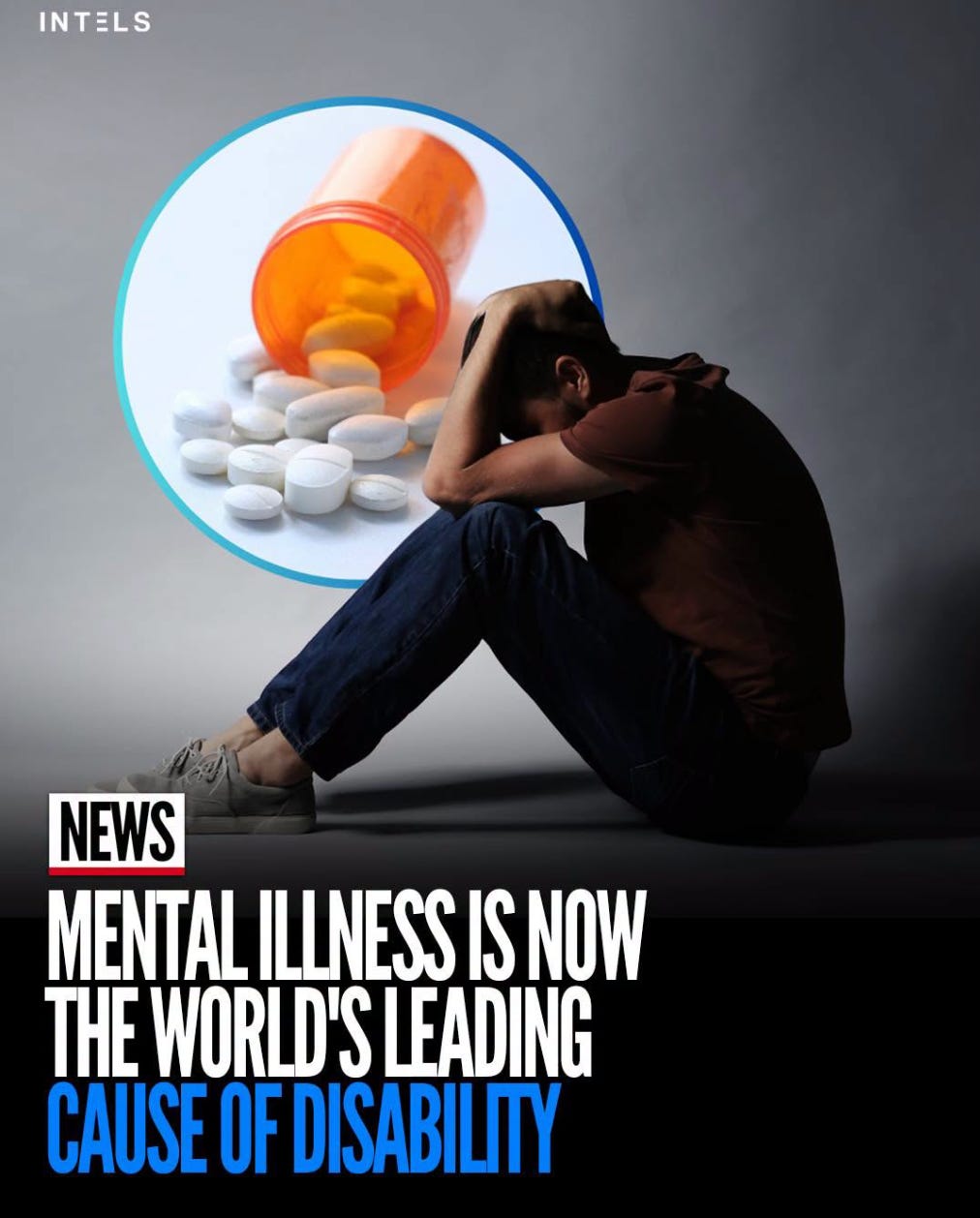
Consider what we are now being asked to accept as normal. The 2026 Lancet Global Burden of Disease study estimates that 1.17 billion human beings, roughly one person in seven on Earth, are living with a mental disorder, and mental disorders now account for 17.3 percent of all years lived with disability worldwide, making them the single largest source of nonfatal disability. Women carry an even greater burden than men, with the female age-standardized mental-disorder burden about 18 percent higher. This is insane, not because hundreds of millions of people do not genuinely suffer from serious psychiatric illness, but because at some point a civilization has to ask what these numbers actually mean. Did humanity suddenly become catastrophically mentally ill, or have we built a medical system that increasingly converts sadness, fear, loneliness, grief, adolescent turmoil and difficulty coping with life into psychiatric pathology? When one in seven people on the planet fits into the modeled category of mental disorder, the diagnostic framework itself deserves scrutiny. A medical system cannot simply keep expanding the definition of sickness and then point to the resulting mountain of sickness as proof that it was right.
Before we continue, a brief word about why paid subscriptions matter.
Essays like this one are increasingly difficult to write in public. Not because the questions are illegitimate, but because even asking them can bring accusations of sexism, misogyny, or worse. We don’t have corporate advertisers deciding which subjects are safe. We don’t have a pharmaceutical company sponsoring the page. And we don’t have an institution standing behind us when we challenge fashionable assumptions about medicine, mental health, feminism, family, or the culture itself.
That independence exists because of our subscribers.
If you value writing that is willing to examine uncomfortable data, question accepted narratives, and occasionally say the thing everyone else in the room is carefully avoiding, please consider becoming a paid subscriber to MALONE.NEWS.
Your subscription doesn’t buy agreement. It buys independence.
And these days, independence is worth protecting.
Toxic Feminism
There was a feminism that told women they should have choices. Then there is the more modern version of feminism that increasingly seems to tell women which choices an enlightened woman is supposed to make. Career is achievement. Marriage is dependence. Motherhood is unpaid labor. Men are potential oppressors. Traditional families are suspect. Finances should always be kept separate, plan for a divorce, financial independence is a must. Independence is liberation, and needing another human being is somehow weakness. Delay marriage. Delay children. Establish the career. Find yourself. Become independent. Never settle. Put yourself first.
There is just one rather awkward problem with this prescription for female happiness: human beings are profoundly social animals, and the scientific literature keeps rediscovering the importance of precisely the relationships that modern culture has spent decades teaching women not to need.
Femininity is Real
There is also an uncomfortable biological reality that modern ideology would prefer to treat as an inconvenience: women are not simply smaller men with different reproductive organs. Progesterone is central to female reproduction, but its effects extend into the brain and behavior. Human research has associated higher progesterone with affiliation, social bonding, sensitivity to relationships and even greater willingness to sacrifice for another person.
Estrogen, particularly estradiol, does far more than regulate reproduction. It acts throughout the female brain, interacting with oxytocin and other neuroendocrine systems involved in mood, sexuality, emotional processing, social attachment, and stress. Together with progesterone and oxytocin, estrogen contributes to the biological systems underlying bonding, maternal behavior, and caregiving. And that capacity for nurturing does not suddenly switch off when there is no baby in the room.
Women show stronger tendencies toward caregiving, empathy, and relational investment, although there is enormous individual variation. Biology is not destiny, but neither is it imaginary. To dismiss these deeply rooted female tendencies as merely products of the patriarchy, or to teach women that caring for and depending upon others is somehow incompatible with independence, comes at a real psychological cost, and we are witnessing this worldwide. A feminism that requires women to deny important parts of their own biology is a strange definition of female liberation.
The female impulse toward attachment, relationship and nurturing cannot simply be dismissed as a patriarchal social construct. There is biology underneath it. A culture that tells women that caring for others is servitude, that motherhood is an impediment to achievement, and that putting another human being ahead of oneself represents oppression may therefore be fighting something considerably older than the patriarchy. It may be fighting female biology itself.
Psychology even has a validated instrument called the Ambivalence Toward Men Inventory, developed specifically to measure hostile prejudices and stereotypes about men. And the hostility is measurable. In a subsequent study of 488 college students, women scored significantly higher than men on the instrument's Hostility Toward Men scale, 2.76 versus 2.25 on a 0-to-5 scale.
How a broader culture came to normalize the sweeping negative generalizations about men, male sexuality, male power and masculinity that would immediately be recognized as prejudice if the sexes were reversed is an interesting question. Hostility between the sexes is not liberation. It poisons precisely the trust, affection and intimacy upon which successful relationships depend.
The evidence surrounding work, family and mental health should make us reconsider what women have been sold as liberation. In one nationally representative study of 4,714 working women, high work-family conflict was associated with 2.29 times the odds of depressive symptoms, with some of the strongest associations occurring among younger, highly educated, higher-income and never-married women. Studies of female physicians and longitudinal studies of working women tell much the same story: when professional life and family life are placed into sustained conflict, mental health suffers.
The mistake was never telling women that they could become physicians, scientists, executives, farmers, entrepreneurs or anything else they were capable of becoming. Of course they could, and they should have been free to do so.
The mistake was turning independence itself into the objective, as though dependence upon people who love us were some sort of character defect. A husband and wife depend upon one another. Children depend upon parents. Parents eventually depend upon their children. Families are elaborate networks of mutual obligation. That isn’t oppression. It is much of what gives human life meaning.
And perhaps most poisonous of all is the idea that relations between men and women should be understood primarily as a contest for power. Teach a generation of women to approach half of humanity with suspicion, to interpret ordinary disagreement through the language of oppression, and to view compromise as surrender, and then act surprised when relationships become difficult. Whatever one chooses to call that worldview, it is a miserable foundation upon which to build intimacy.
Girls do not generally sit through a classroom lesson entitled Marriage Is Bad. The message is subtler than that. From school through college, the language surrounding female success increasingly emphasizes independence, autonomy, empowerment, career, individual rights and self-realization. What is striking is what receives far less emphasis: interdependence, marriage, sacrifice, obligation, motherhood, building a household, choosing a good husband and creating a stable family.
Dependence itself has acquired an almost pathological meaning, as though needing a husband, wife, children or extended family represents personal failure rather than the normal condition of human beings. A girl is repeatedly asked what career she wants when she grows up. How often is she asked what kind of marriage she hopes to build, what kind of mother she hopes to become, or what sacrifices a lasting relationship will require? The lesson does not have to be written on the blackboard to be learned: success is something you achieve individually; family is something you fit around it later, and you would be stupid not to be financially independent before having children, cause men generally aren’t to be trusted to hang around long enough to raise a family.
There is an enormous difference between telling a woman you do not have to marry or have children and telling her, explicitly or implicitly, that marriage and motherhood represent lesser ambitions than professional status. Biology also imposes a deadline that corporate advancement does not. A promotion can arrive at 42. A first child may not. Women deserve to know that when they are 22, not discover it when they are 39.
In our lives, we know two women in their thirties who are in the process of freezing their eggs; evidently, they believe that when they are forty or fifty, they will be in a better position to have a child? And we have another single friend, who at fifty, has decided she has aged out of ever being a mother. All of these women are college-educated professionals, never married, and are coming to terms with their biological clocks running out.
A culture that encourages women to postpone permanent relationships, prioritize professional status, regard dependence as weakness, and treat men principally as a source of danger or oppression should at least be willing to examine the results. If the promised liberation ends with unprecedented numbers of young women anxious, depressed, medicated, lonely and unable to form the families they later discover they wanted, declaring the experiment an unquestionable success is not feminism.
It is marketing.
The Big Lie
And then there is the part nobody is supposed to mention: this arrangement is extraordinarily good for industry. The intact family is an economic institution as well as a social one. Husbands and wives share labor. Grandparents care for grandchildren. Families cook meals, repair things, care for the sick and elderly, grow food, teach children, share houses, lend money, pass down skills and provide an enormous amount of economic activity that never appears on a corporate balance sheet. Break those bonds apart and suddenly nearly everything has to be purchased. Two adults maintaining two households need two rents or mortgages, two sets of utilities, two kitchens and twice the household goods.
Put both parents into full-time employment and families purchase more childcare, prepared food, transportation and other substitutes for work once performed within the home. Send rural children hundreds of miles away to college and then into metropolitan corporate employment, and another generation is separated from grandparents, land, community, and the informal economy of extended family. None of this requires a conspiracy. It requires only incentives. And corporations benefit enormously from this arrangement.
Corporations benefit when people become workers first, consumers second, and family members somewhere farther down the list. The Big Lie was convincing women (and men) that exchanging dependence upon people who loved them for dependence upon employers, banks, universities, childcare companies, and the consumer economy was somehow independence. The destruction of family and community did not make people independent. It merely changed whom they depended upon, and unlike a family, the corporation collected the dividends.
The Result is “Mental Illness”
Going back to those numbers at the beginning of this essay, perhaps we have been asking the wrong question. When 56.3 percent of young white liberal women report having been diagnosed with a mental health condition, the immediate assumption is that something must be terribly wrong with these women. Maybe instead, something is terribly wrong with the culture they have been raised in.
For decades, young people, and young women in particular, have been sold a remarkably destructive definition of success. Leave home. Go deeply into debt for college. Build the career. Delay marriage. Delay children. Treat dependence upon another person as weakness. Treat compromise as surrender. Regard traditional institutions with suspicion. Learn to identify grievances. Put yourself first. And when the loneliness, anxiety, purposelessness and unhappiness arrive, there is an enormous medical industry waiting to provide the diagnosis and, frequently, the prescription.
Then we marvel at the epidemic of mental illness.
Perhaps a significant portion of what we are calling a mental-health crisis is actually a crisis of meaning, belonging and human connection. A pill cannot provide a husband or wife. Therapy cannot manufacture grandchildren around the Thanksgiving table. A diagnosis cannot replace friendship, faith, family, community, useful work, children who need you, parents who depend upon you, or the knowledge that one’s life matters to people other than oneself. Medicine can treat disease. It is considerably less capable of treating a culture that has systematically stripped away many of the institutions that once gave ordinary people purpose.
And men have hardly escaped this experiment. While women report extraordinary levels of anxiety, depression and psychiatric diagnosis, men are killing themselves at vastly higher rates. That should be the flashing red warning light. The ideology of victimhood may teach women to describe their suffering endlessly while feminist teachings overlook the suffering of those assigned the role of “oppressor.”
None of this means returning women to some imaginary 1950s existence or denying anyone education, independence or a career. It means admitting something considerably more radical in 2026: human beings need one another. Men need women. Women need men. Children need parents. Parents need children. Families need communities, and communities need people who remain invested in them. Independence was never the highest human good.
That may be the real Big Lie. We were told that liberation meant needing fewer people, carrying fewer obligations and being free to put ourselves first.
Instead, we became more dependent upon employers, corporations, universities, government programs, therapists, pharmaceutical companies and the marketplace to provide things that families and communities once provided for one another.
And now 1.17 billion people are estimated to be living with a mental disorder.
Perhaps the strangest response imaginable is to look at that number and conclude that the problem is simply that humanity needs more mental-health treatment.
Maybe people need more life.
More family. More marriage. More children. More friendship. More community. More responsibility. More people depending upon them, and more people upon whom they can depend.
That isn’t oppression.
It is called being human.
By JGM/RWM
EXCERPT: Perhaps a significant portion of what we are calling a mental-health crisis is actually a CRISIS OF MEANING, belonging and human connection.
Been in the works a longtime. We noticed back in the 50-60s that the father image,was slowly being denigrated in t.v. comedies